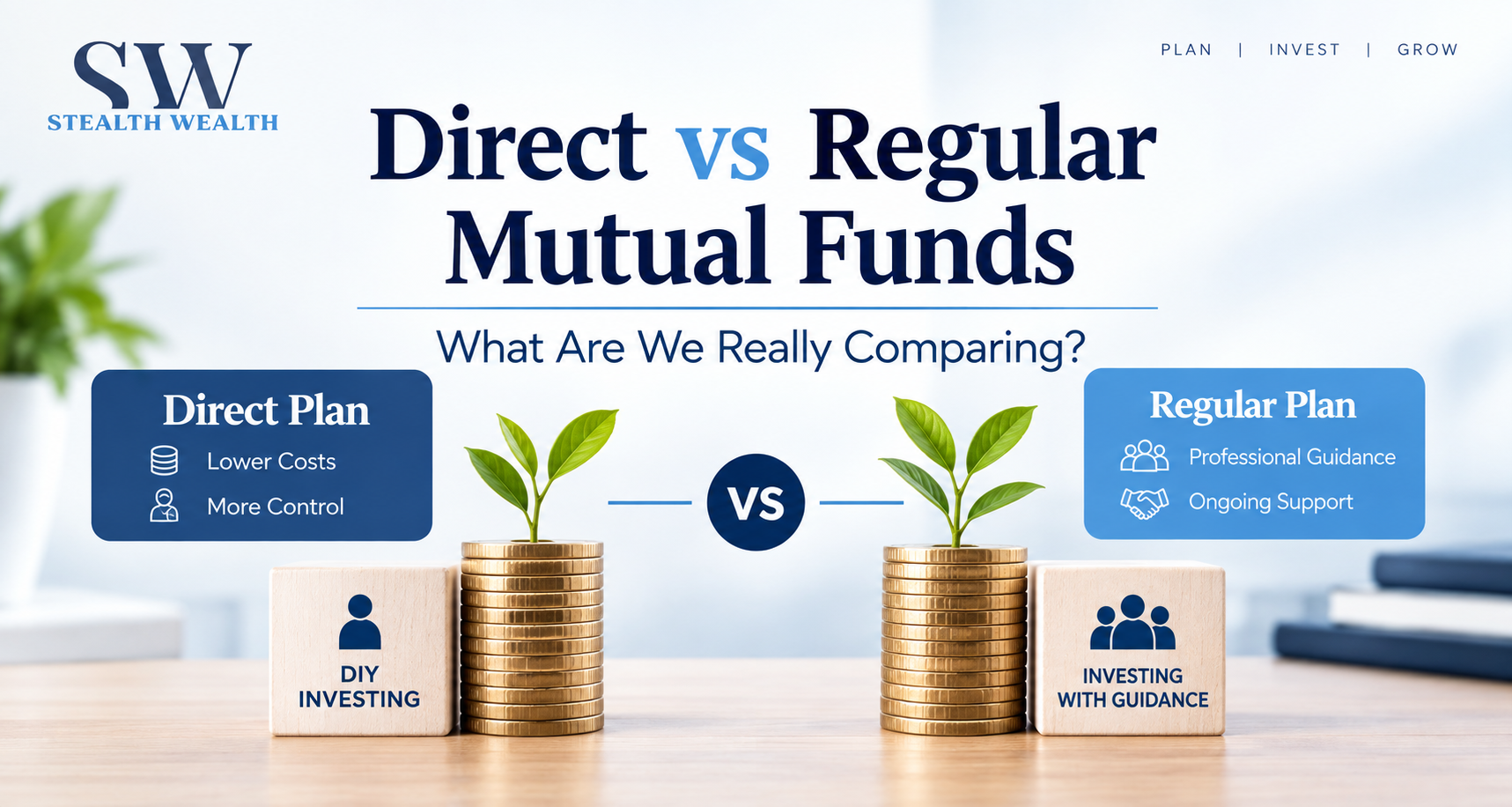
Direct vs Regular Mutual Funds: What Are We Really Comparing?
For years, the debate around Direct vs Regular Mutual Funds has been reduced to a simple question:
“Why should I pay an extra cost when I can invest directly?”
It sounds logical.
Direct Plans generally have a lower expense ratio because there is no distributor commission built into the plan. Regular Plans, on the other hand, are distributed through intermediaries and include distribution-related costs.
But is the entire decision really about saving that cost?
Maybe not.
Because when you invest in a mutual fund, you are not just choosing a fund. You are also choosing how much of the investment journey you want to manage yourself.
Who will research the funds?
Who will construct the portfolio?
Who will review it when your goals change?
Who will help you avoid unnecessary decisions during market volatility?
And perhaps the question most investors don’t think about:
Who will help your family understand your investments when you are no longer around?
That is where the Direct vs Regular conversation becomes much more interesting.
Direct vs Regular Mutual Funds: At a Glance
| Factor | Direct Plan | Regular Plan |
|---|---|---|
| Underlying portfolio | Same scheme portfolio | Same scheme portfolio |
| Fund manager | Same | Same |
| Expense ratio | Generally lower | Generally higher |
| Distributor | No | Yes |
| Professional support | Not inherently included | May be available through intermediary |
| Portfolio responsibility | Primarily investor | Investor with potential intermediary support |
| Tax treatment | Based on applicable tax rules | Based on applicable tax rules |
The first thing to understand is simple:
Direct and Regular Plans of the same mutual fund scheme invest in the same underlying portfolio.
The difference is primarily in the distribution structure and associated costs, not in the quality of the underlying fund. You can read more about the structure of Direct and Regular Plans in AMFI’s explanation of Direct Plans.
Direct vs Regular Mutual Funds : The Real Difference
Imagine two investors, both investing ₹50 lakh into the same mutual fund scheme.
Investor A chooses the Direct Plan.
Investor B chooses the Regular Plan.
Both investors are ultimately invested in the same scheme.
But their investment journeys can look very different.
Investor A may personally research funds, decide the asset allocation, track portfolio performance, monitor overlap, rebalance investments, manage SIPs and make changes when financial goals evolve.
Investor B may work with a distributor who helps with investment execution, servicing, research discussions, portfolio-related requirements and ongoing investment administration.
So the real comparison isn’t simply:
Lower cost vs higher cost.
It can also be:
DIY investing vs investing with professional support.
And that distinction matters.
Direct vs Regular Mutual Funds: What Does a Direct Plan Actually Save You?
Direct Plans generally have a lower expense ratio because they do not include distributor commissions.
Over long periods, even a relatively small difference in cost can have an impact because the money that isn’t paid as an expense remains invested.
That is an important advantage of Direct Plans.
But there is a second side to the equation.
Lower investment cost does not automatically mean lower total effort.
With Direct investing, the investor takes greater responsibility for the investment process.
That can be perfectly reasonable for someone who enjoys researching investments and is comfortable managing their portfolio.
But for someone who doesn’t want to spend weekends comparing funds, tracking portfolios and reviewing financial goals, the calculation is different.
The question becomes:
What is the value of your time, discipline and professional support?
The “1% Extra” Argument
One of the most common statements you hear is:
“Regular Plans cost 1% more.”
But the difference is not universally fixed at 1%.
The expense-ratio difference varies across schemes and can change over time.
So instead of assuming that every Regular Plan costs exactly 1% more, compare the actual expense ratios of the Direct and Regular versions of the specific scheme.
More importantly, don’t look at the cost in isolation.
Ask:
What am I receiving in return for that distribution cost?
If the answer is simply transaction execution, you may evaluate the cost differently than if the relationship includes ongoing servicing, portfolio discussions, research support and help with investment administration.
The value depends on the actual service being provided.
What Can a Good Distributor Actually Add?
This is where the conversation around Regular Plans often becomes too simplistic.
A good professional relationship isn’t just about helping someone purchase a mutual fund.
The real value can come from everything that happens before, between and after transactions.
1. Research Beyond “Which Fund Is Best?”
Investment research should not simply be about finding the fund with the highest recent return.
A more meaningful process can look at:
- Investment objective
- Portfolio construction
- Asset allocation
- Sector concentration
- Portfolio overlap
- Investment strategy
- Risk characteristics
- Fund manager or process changes
- Costs
- The role of the fund within the overall portfolio
The question changes from:
“Which fund is performing best?”
to:
“Which investment actually belongs in this portfolio?”
That is a much more useful question.
2. Building a Portfolio Instead of Collecting Funds
Many investors don’t actually have a portfolio.
They have a collection of mutual funds.
Five funds may have been purchased because a friend recommended one, a colleague mentioned another and an online article suggested something else.
Individually, each fund may look perfectly good.
Together, they may have significant overlap.
You could unknowingly own the same companies across multiple funds, have excessive exposure to a particular sector or take more equity risk than your financial goals require.
Professional portfolio review can help shift the focus from:
“Is this fund good?”
to:
“Does my overall portfolio make sense?”
That is a very different approach to investing.
3. Helping Investors During Market Volatility
The easiest time to follow a financial plan is when everything is going up.
The real test comes when markets fall.
Suddenly, the questions start:
Should I stop my SIP?
Should I sell?
Should I move everything to debt?
Why is my portfolio down when someone else’s is doing well?
A professional relationship can provide an external perspective and help reconnect decisions with the original investment objective. This is where a structured private wealth management approach can bring together investment decisions, financial goals and the broader wealth picture.
This doesn’t guarantee better returns.
Markets cannot be predicted consistently, and no professional can eliminate investment risk.
The potential value lies in having a process and perspective when emotions are strongest.
Sometimes the best investment decision is not making a new decision at all.
4. Reviewing the Portfolio as Life Changes
Your portfolio should not remain unchanged simply because your investments are performing well.
Your life changes.
You get married.
You have children.
You buy a house.
Your income changes.
Your parents may become financially dependent on you.
You approach retirement.
Your goals change.
Your risk-taking ability changes.
Your portfolio should be reviewed in that context.
A professional relationship can help connect the investment portfolio with these changing financial objectives rather than treating every investment as an isolated product.
And Then Comes the Part Most Investors Ignore: Transmission
Let’s take a simple example.
Imagine someone spends 25 years building a ₹5 crore investment portfolio.
There are multiple mutual fund folios, several AMCs, SIPs, old investments, nominations and different financial goals.
Everything is perfectly organised in the investor’s head.
Then something unexpected happens.
The investor is no longer around.
The family doesn’t just inherit ₹5 crore.
They inherit the complexity of understanding where that ₹5 crore is invested.
Which AMC?
Which folio?
Which funds?
Who is the nominee?
What documents are required?
What needs to be transmitted?
Who should the family contact?
This is where a long-term professional relationship can potentially become extremely valuable.
A distributor who has maintained investment records and a servicing relationship may be able to help the family identify investments, understand folios, check nomination details and coordinate the relevant documentation and processes with the AMC/RTA.
Transmission is the process through which the investments of a deceased investor are transferred to the nominee or eligible legal heir. The framework has also been standardised by SEBI to simplify the transmission process. SEBI’s latest transmission framework provides the regulatory reference for the process.
For a detailed explanation of the process, read our guide to mutual fund transmission.
And this is an important distinction:
Of course, professional support does not replace a Will or tax and estate planning.
It does not replace legal or tax advice either. A Will and proper estate planning can also play an important role in ensuring a smoother transfer of wealth to the next generation
But it can make the operational side of transferring financial assets considerably more organised.
And that value doesn’t necessarily appear anywhere on a portfolio statement.
Wealth Management Isn’t Just About Returns
This is perhaps the biggest misconception in the Direct vs Regular debate.
We often try to measure everything through returns.
If one portfolio generated 12% and another generated 11.8%, we immediately assume the first approach created more value.
But what if the second investor:
- Stayed invested during a market crash
- Avoided unnecessary switching
- Maintained the right asset allocation
- Increased investments as income grew
- Had proper nominations
- Kept investment records organised
- Had a clear succession plan
Can all of that be captured simply by comparing two annual returns?
Probably not.
The value of professional support can sometimes be invisible until you need it. For investors considering professional guidance, understanding the role of a CFP professional can also be useful.
Direct + DIY, Regular + Support, or Direct + Advice?
There isn’t only one way to structure your investment journey.
Direct Plan + DIY
You manage the entire process yourself.
This can work well for investors who enjoy research, understand portfolio construction and are comfortable taking responsibility for ongoing decisions.
Regular Plan + Distributor Support
You invest through a distributor and may receive ongoing investment servicing, execution support, research discussions and portfolio-related assistance.
Direct Plan + Separately Paid Advice
You invest through Direct Plans while separately engaging a professional for financial planning or investment advice.
Each model has a different cost and responsibility structure.
The important thing is to understand what you are paying for and what you are responsible for.
So, Direct or Regular Mutual Funds?
There is no universal answer.
If you enjoy managing your own investments, are comfortable researching funds, reviewing your portfolio and staying disciplined, Direct Plans may suit your approach.
If you value an ongoing professional relationship and want support around research, execution, servicing and portfolio management, a Regular Plan may be worth considering.
The important question isn’t simply:
“How much can I save by investing directly?”
Ask the bigger question:
“What am I willing to manage myself, and where could professional support add value?”
Because the cheapest investment isn’t necessarily the one with the lowest expense ratio.
Sometimes, value comes from having a better process.
Sometimes, it comes from avoiding unnecessary decisions.
Sometimes, it comes from having someone challenge your assumptions.
And sometimes, it becomes visible years later—when your family needs to understand and transition the wealth you spent decades building.
Wealth management isn’t only about growing money.
It’s about managing it, protecting it, organising it and eventually making sure it reaches the next generation in the right way.
Frequently Asked Questions
Are Direct and Regular Mutual Funds the same?
For the same scheme, Direct and Regular Plans have the same underlying portfolio and are managed by the same fund manager. The primary difference is the distribution structure and expense ratio.
Are Direct Plans cheaper?
Generally, yes. Direct Plans do not include distributor commissions and therefore generally have a lower expense ratio than the corresponding Regular Plan.
Do Direct and Regular Plans have different tax rates?
No. The Direct or Regular label itself does not determine the applicable tax rate. Tax treatment depends on the nature of the investment and applicable tax rules.
Can I invest in Direct Plans and still take professional advice?
Yes. An investor can invest through Direct Plans and separately engage an appropriately qualified and regulated professional for financial planning or investment advice, depending on the services required.
Is Regular Plan always better if I need help?
Not necessarily. The important thing is to understand the actual service being provided, its cost and whether it adds value to your investment process.
Final Thought
The Direct vs Regular debate shouldn’t simply be about “saving 1%.”
It should be about understanding the complete equation:
Cost + Expertise + Time + Discipline + Service + Continuity.
Because building wealth is only one part of wealth management.
The real job is to make that wealth work for you today—and make it easier for your family to understand tomorrow.
Disclaimer: Mutual fund investments are subject to market risks. Read all scheme-related documents carefully before investing. This article is for educational purposes only and should not be considered investment, legal or tax advice. Past performance is not indicative of future results.
